
Quick Summary for Parents
Transitioning your child from home, ABA, or private school into the public school system can feel overwhelming—but it doesn’t have to be.
This guide walks you through a clear, structured 7-step process, from enrollment to ongoing progress monitoring. Each step is designed to help you understand what the school will do, what decisions will be made, and how you can actively advocate for your child.
At every stage, the goal is the same:
to ensure your child enters a school environment where they can learn, regulate, and thrive—not just be placed.
Step 1: Enroll in Your Local School
The first step is getting your child formally into the system.
You will:
- Contact your zoned school
- Submit required documents (ID, proof of residence, prior records)
- Share any previous evaluations or therapy reports
If your child is ages 3–5, you may instead:
- Contact the district’s Early Childhood / ESCE department
- Request evaluation through Child Find
👉 This step officially starts the process and ensures the school has access to your child’s history and needs.
How Cully Supports You
We help organize and review your child’s records so nothing important is missed—and position your child’s needs clearly from the start.
Step 2: Request a School Evaluation
Once enrolled, you will submit a written request for a special education evaluation.
The school may:
- Review existing reports
- Conduct their own testing (Full Individual Evaluation – FIE)
This evaluation looks at:
- Academic skills
- Communication
- Social/emotional functioning
- Behavior and attention
- Autism characteristics (if applicable)
👉 This step determines eligibility for special education services.
How Cully Supports You
We help you:
- Understand what to request
- Prepare for the evaluation process
- Ensure the results truly reflect your child’s needs
Step 3: Review the Full Individual Evaluation (FIE)
After testing, the school provides a comprehensive evaluation report.
This report:
- Identifies your child’s strengths and needs
- Determines eligibility
- Drives all future decisions (placement, services, supports)
👉 This is one of the most important steps—everything builds from here.
What Parents Should Do
- Ask questions
- Clarify anything unclear
- Make sure the report reflects your child accurately
How Cully Supports You
We break down the evaluation in plain language and identify:
- Gaps or concerns
- Areas that may impact placement or services
- Whether further evaluation (IEE) should be considered
Step 4: Attend the IEP (ARD) Meeting
The ARD/IEP meeting is where your child’s educational plan is created.
This includes:
- Goals
- Supports & accommodations
- Services (speech, OT, etc.)
- Behavioral supports
👉 This becomes your child’s roadmap for learning in school.
How Cully Supports You
We help you:
- Prepare for the meeting
- Review goals and services
- Advocate effectively during discussions
Step 5: Determine Placement & Supports
The ARD team decides where and how your child will be supported.
Options may include:
- General education with supports
- Inclusion or resource support
- Specialized programs or classrooms
The guiding principle is Least Restrictive Environment (LRE):
Your child should receive needed support while staying as included as possible.
👉 Placement decisions must be individualized—not one-size-fits-all.
How Cully Supports You
We:
- Compare placement recommendations with evaluation data
- Identify whether supports are sufficient
- Help you advocate if changes are needed
Step 6: Begin Services
Once the plan is finalized:
- Services and supports are implemented
- Teachers and therapists begin working on IEP goals
👉 This is where the plan becomes real, day-to-day support for your child.
Important Insight
Transition into school can be challenging—especially for children with autism.
Changes in environment, expectations, and relationships must be carefully supported.
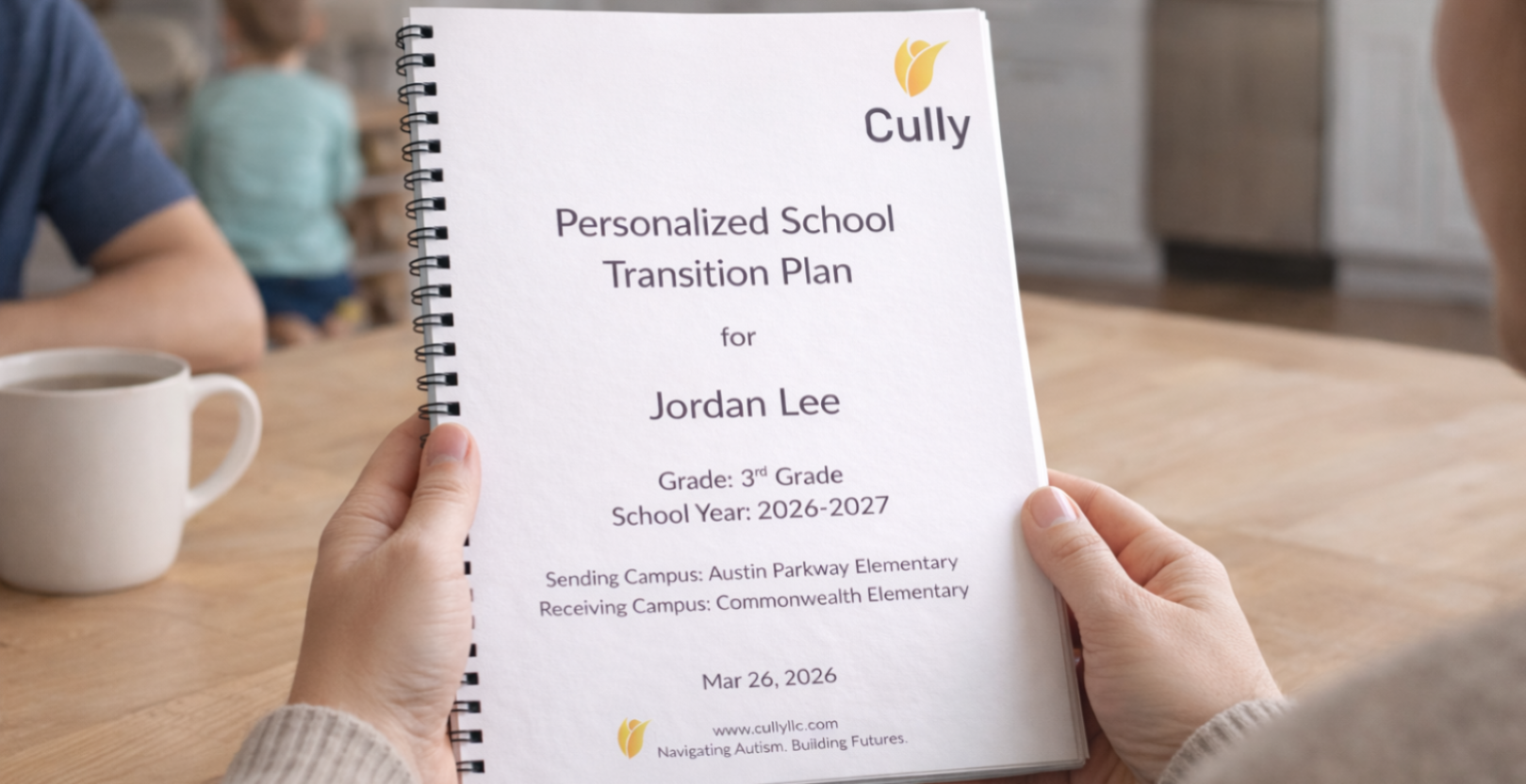
How Cully Supports You
We help create structured transition strategies such as:
- Pre-visits to school
- Visual schedules
- Gradual entry plans
- Coordination with staff
Step 7: Monitor Progress
This is an ongoing, critical step.
Parents should:
- Track progress regularly
- Stay in communication with the school
- Request meetings if concerns arise
- Adjust supports when needed
👉 The plan should evolve as your child grows.
How Cully Supports You
We:
- Review progress data
- Prepare you for ARD meetings
- Help you advocate for changes when needed
Key Takeaways for Parents
- Every child starts from a different place—some have evaluations, others don’t
- The evaluation (FIE) drives everything—take time to understand it
- Placement must follow LRE, but also truly meet your child’s needs
- The IEP is your child’s roadmap—it must be specific and meaningful
- Transitions into school should be planned, not rushed
- Progress should be monitored and adjusted continuously
You Don’t Have to Do This Alone
Navigating the public school system can feel complex—but with the right structure and guidance, it becomes manageable.
At every step—from enrollment to ongoing support—
Cully works alongside families to ensure children are not just placed, but set up to succeed.