
A New School Doesn’t Have to Mean Starting Over
If your child has an IEP, the thought of changing schools can feel overwhelming.
Questions start racing through your mind.
Will the new teachers understand my child?
Will they know what works—and what doesn’t?
Will my child lose all the progress we’ve worked so hard to achieve?
If you’ve found yourself worrying about these questions, you’re not alone.
Whether your family is moving, your child is transitioning to middle or high school, changing campuses, or entering public school for the first time, it can feel like you’re starting all over again.
For children with autism and other developmental differences, these transitions often involve much more than just walking into a different building.
They involve leaving behind familiar teachers, trusted routines, supportive relationships, and carefully developed strategies that may have taken years to build.
The good news is that it doesn’t have to be this way.
With thoughtful planning and the right support, your child’s new school can be prepared before the first day, helping the transition feel far less overwhelming—for both your child and your family.
Why School Transitions Can Be Difficult
Every child experiences change differently.
For many children with autism, predictability creates a sense of safety. Familiar routines, trusted adults, and consistent expectations help them feel confident enough to learn, communicate, and build relationships.
Changing schools often means changing all of those things at once.
Your child may be adjusting to:
- A new campus
- New teachers and support staff
- Different classroom routines
- New classmates
- Different sensory environments
- Changes in transportation and daily schedules
Even children who have been thriving may experience setbacks.
Parents often notice increased anxiety, emotional outbursts, school refusal, sleep difficulties, or regression in skills that may last well beyond the first few weeks.
These challenges are often a sign that your child is working incredibly hard to adapt to a completely new environment.
The Questions Most Parents Ask
Over the years, we’ve had countless conversations with parents preparing for a school transition.
Many of them ask the same questions:
- How can I prepare my child before the first day?
- Will my child’s IEP actually be followed?
- How do I make sure the new school understands my child?
- What happens if my child struggles in this new environment?
- Will I have to start explaining everything from the beginning again?
These aren’t just logistical questions.
They reflect something much deeper:
“Will my child be okay?”
That’s exactly why preparation matters.
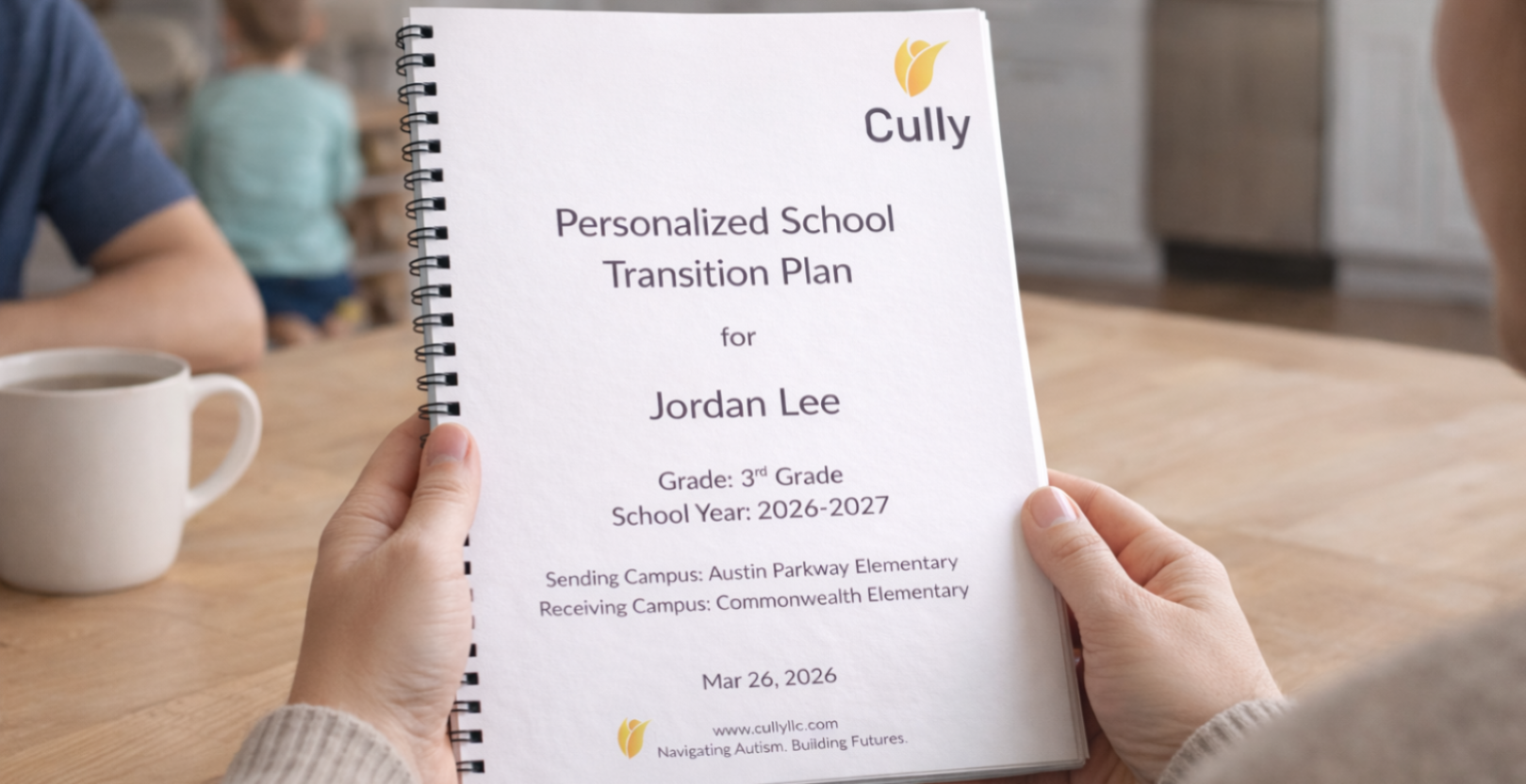
Introducing the Cully Personalized Transition Plan
After supporting children with autism and their families for more than 20 years, we’ve learned that successful school transitions rarely happen by accident.
They happen because someone takes the time to prepare everyone involved before challenges arise.
That’s why we created the Cully Personalized Transition Plan.
Rather than waiting until a child begins struggling in a new environment, we take a proactive approach that prepares the child, the family, and the educational team before the transition occurs.
Our goal is simple:
To help your child’s new school understand who they are, what helps them succeed, and how to support them from day one.
Phase 1 – Understanding Your Child Beyond the Paperwork
Every successful transition begins with understanding the whole child.
We begin with a Comprehensive Record Review, carefully examining your child’s educational history to identify the strategies, supports, and accommodations that have helped them succeed.
This may include reviewing:
- Psychological and educational evaluations
- Current and previous IEPs and ARD documentation
- Behavior Intervention Plans
- Therapy reports
- Progress reports
- Patterns of progress, regression, and support needs
These records often contain a goldmine of insight that shouldn’t be lost simply because a child is changing schools.
But paperwork only tells part of the story.
Whenever possible, we also take time to get to know your child.
We observe how they communicate, interact, regulate emotions, respond to different situations, and engage with others.
This allows us to understand not only what your child needs—but who they are.
The result is a Personalized Transition Plan that reflects your child’s unique strengths, personality, learning style, and support needs.
Phase 2 – Helping the New School Be Ready Before Your Child Arrives
One of the biggest fears parents have is feeling like everyone at the new school has to start from scratch.
Once the transition plan has been developed, we help ensure that the people supporting your child understand how to put it into practice before school begins.
Depending on your family’s situation, this may include participating in an ARD or IEP meeting, collaborating with the receiving school, or providing the educational team with practical recommendations that help them better understand your child from the very beginning.
Preparation may include:
- Sharing the Personalized Transition Plan with the receiving school
- Meeting with teachers or administrators before school starts
- Visiting the new campus
- Creating visual supports or social stories
- Developing sensory regulation strategies
- Identifying routines that should remain consistent
- Ensuring key accommodations are in place before the first day
Instead of reacting after problems occur, everyone begins with a shared understanding of what helps your child feel successful.
Phase 3 – Supporting the Transition After School Begins
The first day of school isn’t the finish line.
It’s just the beginning.
During the first several weeks, we encourage families to pay close attention to how their child is adjusting.
We may monitor areas such as:
- Emotional regulation
- Anxiety and stress
- Classroom participation
- Social interactions
- Academic engagement
- Behavioral changes
- The effectiveness of accommodations
- Communication between home and school
Sometimes children settle in quickly.
Sometimes small adjustments make all the difference.
By identifying concerns early, families and schools can work together to provide additional support before small challenges become larger ones.
What You Can Do Before the First Day
Parents play one of the most important roles in helping a child feel confident about a new school.
Simple preparation can have a big impact.
Whenever possible:
- Visit the new campus before school starts.
- Walk from the entrance to the classroom.
- Visit the playground, cafeteria, and other common areas.
- Meet teachers or support staff.
- Practice the morning routine.
- Create a visual schedule or social story.
- Talk positively about the transition while acknowledging your child’s feelings.
- Keep home routines as predictable as possible.
Children often become less anxious when the unfamiliar becomes familiar.
Remember—You Don’t Have to Do This Alone
Many parents tell us they feel like they’re carrying the entire weight of their child’s education.
Coordinating therapists.
Communicating with teachers.
Preparing for ARD meetings.
Advocating for services.
Trying to make the right decisions.
Trying to hold everything together.
It can be exhausting.
One of the greatest benefits of having a structured transition plan is knowing that someone else is helping you think through the process—someone who understands both autism and the educational system.
You don’t have to figure everything out on your own.
Key Takeaway
Changing schools can be stressful, but it doesn’t have to mean starting over.
With thoughtful planning, proactive communication, and individualized support, children with autism and developmental differences can transition successfully while continuing to build on the progress they’ve already made.
At Cully, we believe every child deserves to walk into a new school with people who understand their strengths—not just their challenges.
That’s why we created the Cully Personalized Transition Plan: to help families navigate school transitions with greater confidence, clarity, and peace of mind.
Ready to Help Your Child Transition with Confidence?
Schedule a free 30-minute consultation to discuss your child’s unique needs and learn how the Cully Personalized Transition Plan can help them start this next chapter with confidence.
Or call us directly at 281-822-2482.